

Most people use digital services every day without thinking about where they run.
Sending a message, watching a video, saving a document, or accessing a business application all feel immediate. But behind each of these actions is a system that stores information, processes requests, and sends results back in seconds.
That system is supported by data centers.
A Simple Definition of a Data Center
A data center is a facility where information is stored and processed so it can be accessed when needed.
Instead of keeping data on a single device, information is handled in systems designed to support many users at the same time. This allows people and businesses to access services from different locations without managing the underlying systems themselves.
If you’ve read about how everyday services depend on connected systems, data centers are a central part of that foundation.
How the Internet Supports the Things Communities Depend On
How a Data Center Works
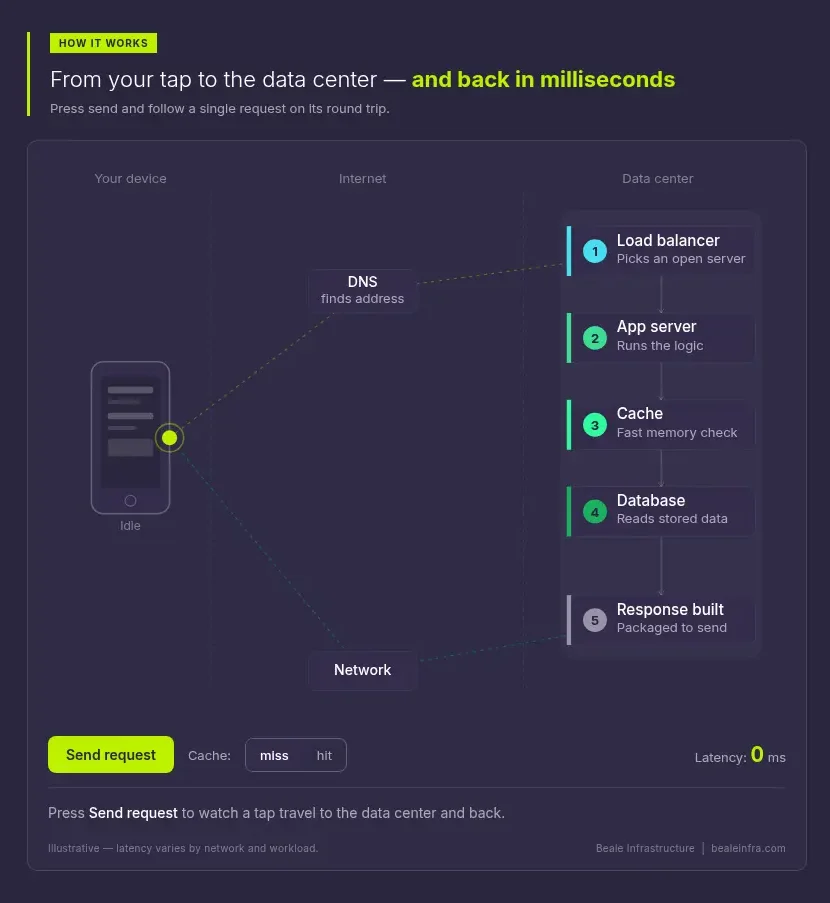
When someone uses an online service, a simple process takes place.
For example, when you open Netflix and press play on a show:
Step 1: A request is sent
Your device sends a request through the internet asking for that specific video.
Step 2: The request is processed
The request is routed to a data center, where the video is stored. The system locates the content and prepares it to be delivered.
Step 3: A response is returned
The video is sent back to your device in a continuous stream, allowing it to play almost instantly.
This same process happens when you send a message, load a website, or complete a payment. It all relies on information being requested, processed, and returned in real time.
Where Data Centers Are Located
Data centers are typically built in areas where people live and work, and where the necessary infrastructure already exists.
This often includes major metropolitan regions and growing population centers. These locations provide access to power, strong network connectivity, and the ability to connect users to services with minimal delay.
You’ll find concentrations of data centers in regions like Northern Virginia, Dallas, Phoenix, Chicago, and Silicon Valley, but they are distributed across the country to support different communities and needs.
How Many There Are
There are several thousand data centers across the United States, making it the largest data center market in the world.
Estimates vary depending on how facilities are counted, but all show a large and growing footprint. Some are large commercial facilities, while others support specific businesses or organizations.
Together, they form a network that supports the digital services people use every day.
What a Data Center Looks Like
From the outside, a data center is typically a low-profile building designed for security and reliability. It does not operate like a factory or industrial plant.
Inside, the environment is controlled and organized. Systems are arranged to manage airflow, temperature, and power consistently. Most facilities are quiet, highly monitored, and designed to operate continuously.
They are built for stability and reliability, not for visibility.
Why It Matters
When these systems work well, services are fast, reliable, and easy to access.
When they do not, the impact is immediate. Applications slow down, information becomes harder to access, and everyday tasks take longer to complete.
Data centers help support the consistency and reliability people expect from the services they use every day.
A data center is not something most people see or interact with directly.
But it plays a central role in how information is stored, processed, and delivered, supporting many of the systems that communities rely on every day.