Project Snapshot
Campus Design
Phased hyperscale data center campus.
Long-term buildout could include up to 16 data halls across multiple buildings
Location
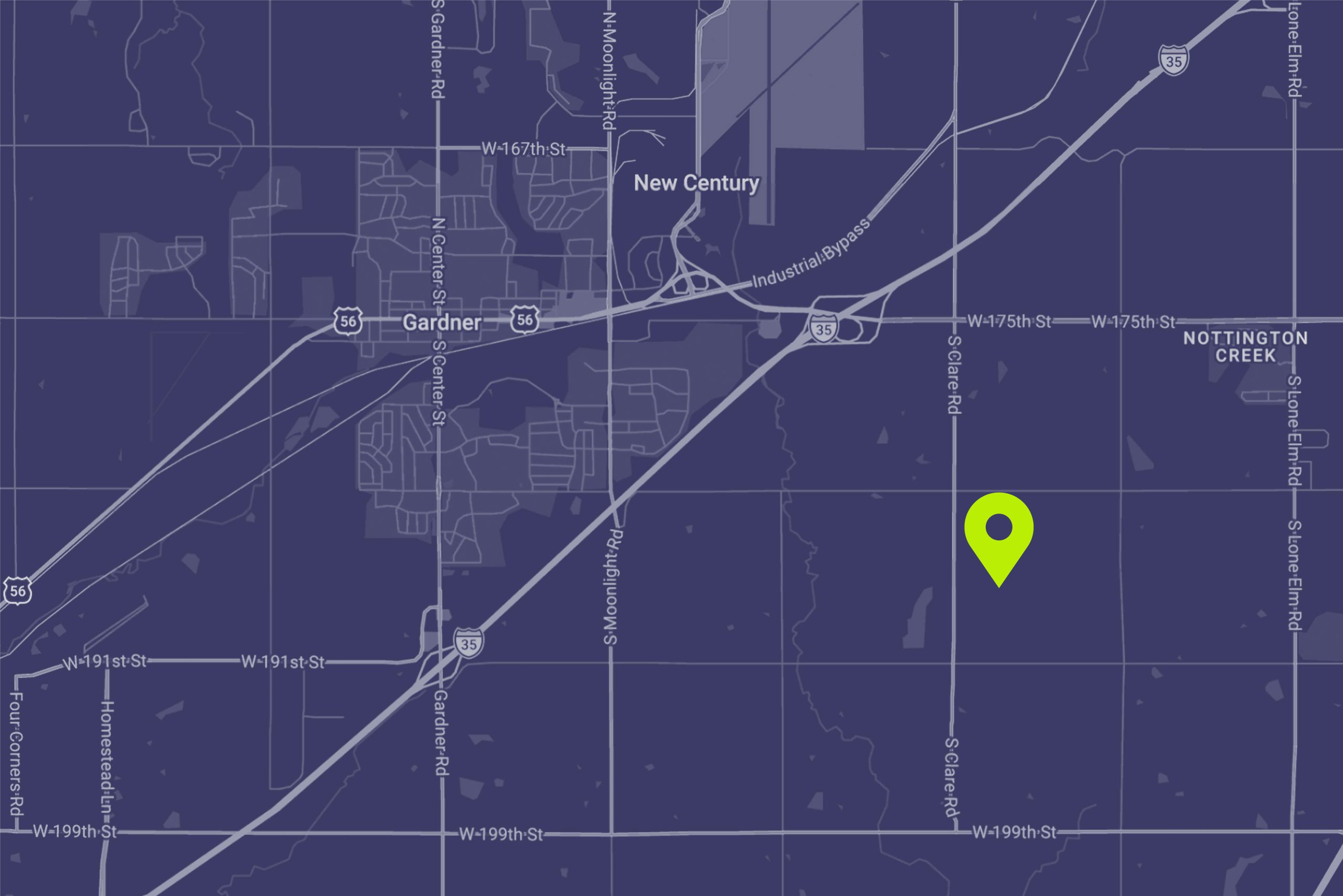
Gardner, Kansas
Near 191st Street and South Clare Road Approximately 300-acre site
Utility Service Providers
Electric service provided by Evergy
Relative Economic Significance
Among the largest private infrastructure investments in Johnson County
Community Benefits

Tax Revenue
The project is expected to become one of Johnson Countyʼs largest taxpayers at full buildout. It will contribute to property tax revenue increases that support local school districts and generate franchise fee revenue from energy sales that support public services. Data centers require relatively few municipal services – such as police, medical or fire response – compared to their tax contribution, strengthening long-term fiscal stability.

Infrastructure Improvements
The project includes new and upgraded electrical infrastructure, including a private on-site substation and a new Evergy substation designed to strengthen regional grid reliability. All roadway, water, and electrical infrastructure improvements required to serve the campus will be privately funded.

New Jobs
During construction, the project is expected to support hundreds of contractor and trade positions, and generate demand for local businesses. Initial operations are expected to support approximately 50 full-time on-site positions, with additional roles added as future phases are developed. These positions are long-term roles with average salaries exceeding $75,000 plus benefits.

Community First
The Gardner data center project is designed to deliver sustained economic benefit while limiting demand on local infrastructure and services. Compared with many alternative land uses – such as warehousing or residential – the project generates substantial tax revenue with lower long-term service costs and reduced operational impacts.
Site Plan
The campus is designed to operate in a way that maintains compatibility with surrounding rural and residential areas. Site planning focuses on substantial separation from neighboring properties, controlled building scale, and mitigation of noise and lighting impacts.
Planned setbacks extend hundreds of feet, and existing landscaping will be preserved where possible to maintain visual buffers. Building heights will comply with the City of Gardnerʼs 60-foot limit.
Sound mitigation measures, including berms and acoustic treatment where needed, are incorporated to maintain carefully controlled operational noise levels. Exterior lighting will be shielded and directed downward to prevent glare or spillover onto surrounding properties.
Traffic studies and access plans will be completed and submitted as part of the formal review process.

Additional Project Detail
- The project will be served by Evergy and includes private on-site substations as well as a new Evergy substation to strengthen regional grid reliability and resiliency.
- Evergy’s power generation portfolio includes significant renewable resources.
- The Kansas Corporation Commission’s Large Load Power Supply tariff ensures large customers pay their share of infrastructure upgrades while protecting other ratepayers.
- Where on-site generation is used, it will function as a resiliency measure and operate under strict emissions and noise standards.
- The facility is expected to align with modern energy efficiency standards, including compliance with the International Energy Conservation Code.
- The primary cooling of the data center equipment will use a closed-loop, air-cooled system, which does not continuously consume water for industrial cooling purposes
- After the initial closed loop fill-up, water will be used for “domestic” purposes only, such as employee kitchens, bathrooms, hand washing, and health/safety requirements.
- On average, the facility is estimated to use 15,000 to 20,000 gallons per day, depending on occupancy, which is roughly the same as two to three sit down restaurants.
- Any required water transmission upgrades are expected to be limited and would be privately funded by Beale.
- Domestic wastewater will be managed through local treatment systems.
- If water-based cooling is implemented, water will be extensively recycled and managed through approved treatment processes to ensure compliance with regulatory standards.
- Water rates are established by WaterOne.
- Operational sound mitigation is incorporated into the campus design, including berms, sound walls, and acoustic treatment where needed.
- Operations are designed to maintain carefully controlled sound levels at surrounding properties.
- Buildings are largely windowless with limited exterior lighting.
- Fixtures are shielded and directed downward to prevent spillover onto surrounding properties and minimize nighttime visibility.
- The project must meet all applicable federal, state and local environmental requirements before construction or operations begin.
- Required permits include stormwater, air quality, and wastewater approvals from the U.S. Environmental Protection Agency, the Kansas Department of Health and Environment, Johnson County, and the City of Gardner.
- Regulatory agencies maintain inspection authority throughout construction and operations.
- Backup generators are limited by federal law, must meet strict emissions standards, and are acoustically treated.
- The project must pass required inspections before facilities can begin operating.
- The project is designed to provide substantial tax revenue while placing relatively limited demand on public services.
- The campus operates without manufacturing activity or heavy truck traffic, and maintains significant setbacks and visual buffers.
- Compared with many alternative land uses, the project delivers higher tax revenue with lower long-term service costs and controlled operational impacts.
- Wetlands and stream corridors will be protected in accordance with local streamway protection standards. In the event impacts are unavoidable, approved mitigation measures will be implemented.
Project Timeline
The Gardner data center project is currently in the early planning phase.
| Rezoning & Preliminary Planned Development Application | In progress |
| Planning Commission Review | May 26, 2026 |
| City Council Consideration | June 15, 2026 |
| Infrastructure Growth & Site Readiness | Ongoing |
| Construction Start | To be determined |